
China to expand imports of advanced tech, key components, high-quality agricultural products: customs official
 Add
Add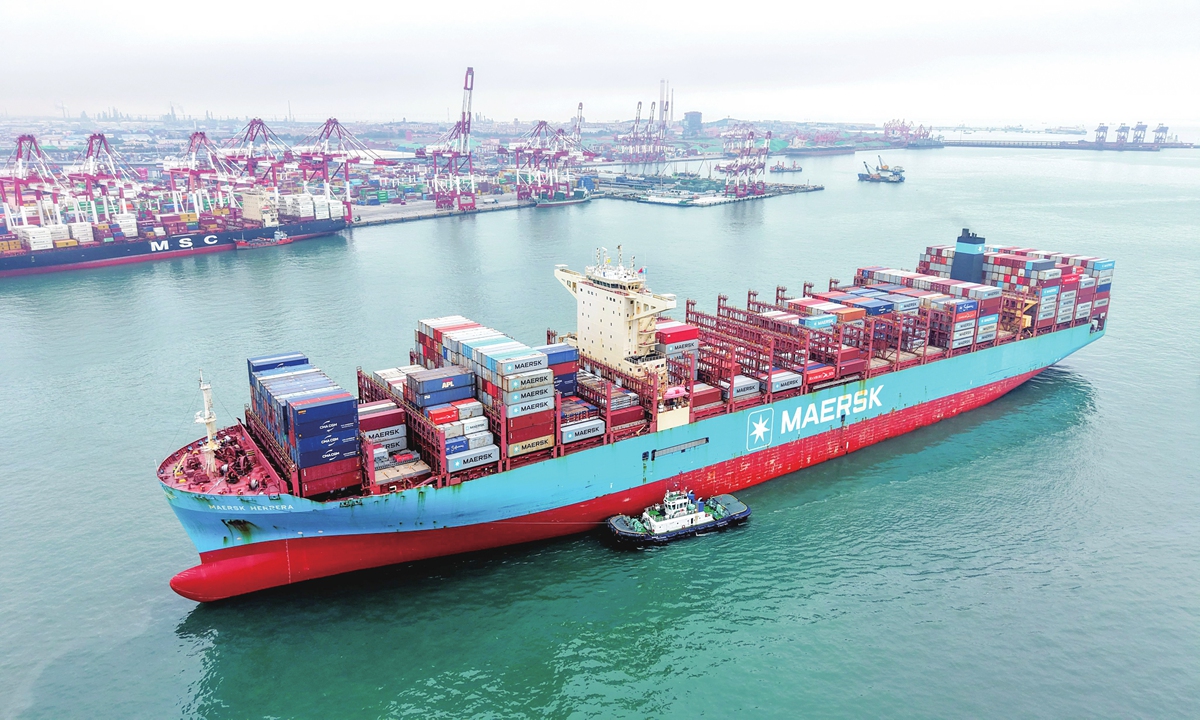
A cargo ship loaded with foreign trade containers enters a port in Qingdao, East China's Shandong Province, on July 16, 2026. Photo: VCG
China will expand imports of advanced technology and equipment, key components, energy resources, and high-quality agricultural products while broadening their source countries during the 15th Five-Year Plan (2026-30) period, Sun Meijun, head of the General Administration of Customs (GAC), said on Wednesday.
Chinese experts said that China's move to expand high-quality imports reflects its continued commitment to openness and sharing market opportunities, as the country's industrial upgrading and consumer demand create greater demand for global resources. This contrasts with some Western countries' trade restrictions and signals China's willingness to uphold fair competition.
Sun made the remarks during a press conference on accelerating the building of a strong trade powerhouse, saying that the measures will facilitate exports of global quality goods to China, share the opportunities of China's huge market, and offer Chinese consumers more diverse choices.
In the first half of this year, China's total trade, as well as imports and exports alone, all achieved double-digit growth rates. Imported goods have effectively met the needs of developing new quality productive forces, industrial upgrading, and consumption upgrading in China. Exported products have precisely matched international market demand, with good quality, high cost-effectiveness, and strong competitiveness, Sun said.
The official noted that the expansion of domestic demand has driven faster growth of imports, with an expansion rate that was 8.7 percentage points higher than export growth. China is not only "the world's factory," but also "the world's market." Moreover, through proactive opening-up and expanded imports, China's commerce authorities have launched the "Export to China" series of activities.
"China has long been committed to promoting the balanced development of imports and exports, and actively imports products that meet domestic needs. These measures will further promote the diversification of import sources and create more opportunities for trading partners to expand their exports to China," Zhou Mi, a senior researcher at the Chinese Academy of International Trade and Economic Cooperation, told the Global Times on Wednesday.
For a long time, some Western countries have imposed export controls on high-tech products and technologies to China under the pretext of national security, particularly imposing strict restrictions in fields such as semiconductors, advanced manufacturing equipment, and precision instruments, Zhou said, noting that this unilateral stance has directly cut the imports of high-tech products and reduced the overall import volume.
In the field of high-end manufacturing, China has gradually built competitiveness, with relevant products not only meeting domestic demand but also being exported to global markets, the expert said.
In terms of the imports of agricultural products, Zhou noted that agricultural products constitute a key priority for many trading partners exporting to China. "Given China's vast population, the country maintains a strong and sustainable demand for food and agricultural products. This demand is relatively unique on a global scale and is capable of creating broad opportunities for cooperation and greater prospects for more trading partners," the expert said.
Wang Jun, spokesperson for the GAC, said that from "cherry freedom" to "durian freedom," more and more global quality goods are "flying into Chinese ordinary households."
This is not only a vivid reflection of China's continued opening of its market and sharing development opportunities with the world, but also a true portrayal of expanding imports to better meet the people's needs for a higher quality of life, the official said.
China has become a major trading partner for more than 160 countries and regions. Imported goods now come from a broader range of sources, with more varieties and an improved structure. Shipments of milk from Oceania, coffee from Africa, and fresh chilled salmon from Europe are crossing the seas to enter the "shopping carts" of ordinary Chinese homes, according to Wang.
Since the beginning of this year, China has granted market access to 264 types of agricultural and food products from 79 additional countries. The sources of imported agricultural and food products now cover more than 150 countries and regions worldwide. We will continue to optimize quarantine and market access procedures for agricultural and food products while ensuring safety, and further broaden diversified import channels, Wang said.
As the domestic economy continues to improve and consumption potential is further unleashed, Chinese consumers will enjoy more high-quality goods from around the world. At the same time, countries worldwide will benefit from greater market dividends through China's expanded imports, the spokesperson said.